Table of Contents
- Why Sleep Quality Matters More Than Just Falling Asleep
- Best Cannabis Strains for Sleep Quality: A Quick Reference
- Best Indica Strains for Sleep: Granddaddy Purple, Northern Lights, and More
- Best Cannabis Strains for Insomnia: When You Need Fast Sleep Onset
- THC vs. CBD for Sleep: What the Label Doesn’t Tell You
- Cannabis Terpenes for Sleep: Myrcene, Linalool, and Caryophyllene
- How to Choose a Cannabis Strain for Sleep: Dose, Timing, and Tolerance
- Conclusion: Building a Better Nighttime Routine
- Frequently Asked Questions
Last Updated: October 15, 2026
Why Sleep Quality Matters More Than Just Falling Asleep
Sleep quality is how rested you feel when you wake up, not how fast you drifted off.
That gap matters when you pick a cannabis strains for sleep product.
The CDC guidance on sleep and chronic disease notes that poor sleep is tied to a long list of health problems, from heart issues to depression.
Most guides rank strains by how hard they hit. We rank them by what they do after you’re already asleep.
Best Cannabis Strains for Sleep Quality: A Quick Reference
The best cannabis strains for sleep quality tend to be indica-dominant hybrids with high myrcene and moderate THC. Here are the varieties most often recommended for nighttime use:
- Granddaddy Purple – heavy body relaxation, classic grape aroma
- Northern Lights – fast onset, gentle come-down
- Bubba Kush – deep sedation, good for pain-related insomnia
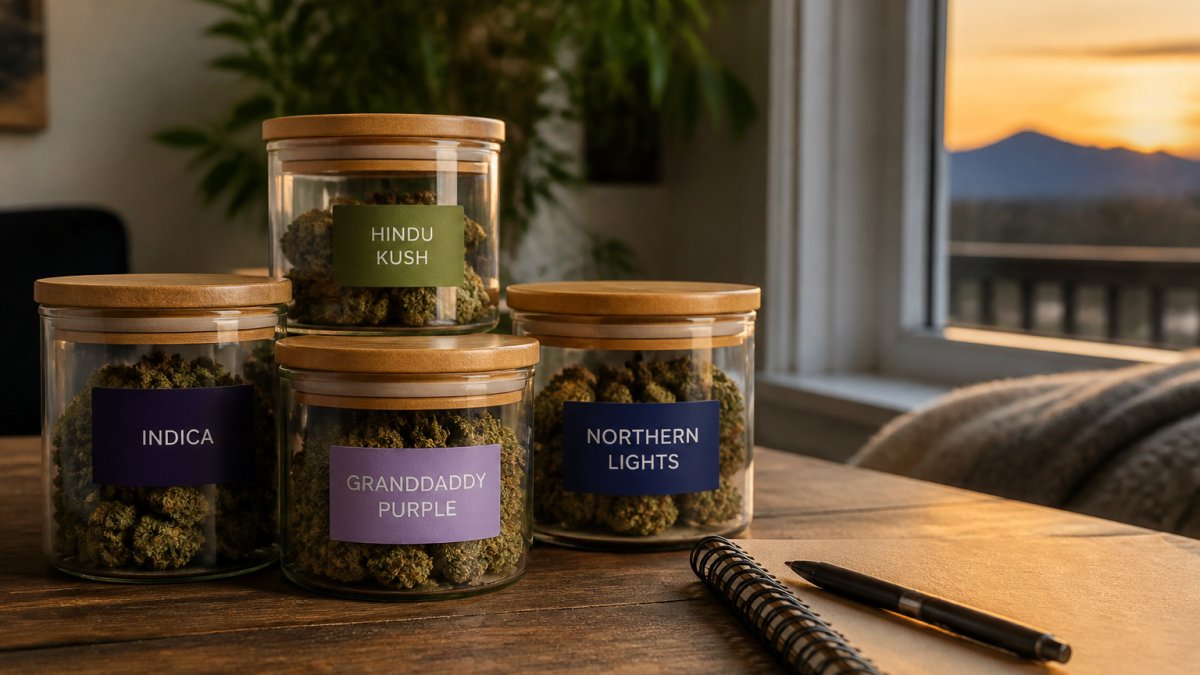
Selecting the right cultivar acts as a foundational step toward improving sleep quality, though addressing underlying lifestyle habits remains essential for achieving consistent rest.
Here’s a quick comparison of how these strains differ:
| Strain | Type | THC Level | Best For |
|---|---|---|---|
| Granddaddy Purple | Indica | High | Deep body relaxation |
| Northern Lights | Indica | Moderate-High | Fast sleep onset |
| Bubba Kush | Indica | High | Pain-related insomnia |
| Afghan Kush | Indica | Moderate-High | Long sleep duration |
| Purple Kush | Indica | Moderate | Balanced relaxation |
| Harlequin | Sativa-dominant | Low | Daytime calm, low impairment |
What the Research Actually Shows (and What It Doesn’t)
Honest answer: the research on cannabis and sleep is thin. Most studies are small, short, and rely on self-reported sleep quality, and no large trial shows any single strain reliably fixes insomnia.
In practice, THC can shorten time to fall asleep but may reduce REM sleep, which is why some users wake up foggy. CBD shows mixed results. Treat strain names as starting points, not guarantees, your body, tolerance, and dose matter more than the label.
Best Indica Strains for Sleep: Granddaddy Purple, Northern Lights, and More
Indica strains are the default sleep choice because they produce body-heavy, calming effects.
Granddaddy Purple is the most cited pick, with a slow, full-body heaviness that settles in within 15-30 minutes.
Bubba Kush suits insomnia tied to physical pain, with deep, lasting sedation.
Afghan Kush is a landrace indica with a long, steady effect.
A common mistake is chasing the highest THC percentage.
Best Cannabis Strains for Insomnia: When You Need Fast Sleep Onset
If you lie awake for an hour, you want fast onset. The best cannabis strains for insomnia act within 10-20 minutes and don’t leave you wired.
- Northern Lights – onset in about 10-15 minutes
- Purple Kush – onset in about 15 minutes, mild head effect
- Granddaddy Purple – onset in about 20 minutes, heavier body load
Timing matters as much as the strain. Inhaled flower hits in minutes. Edibles can take 60-120 minutes, which is why so many people overdo it and wake up groggy.
If you’re new to cannabis for sleep, start with one or two puffs of a moderate-THC indica about 30 minutes before bed. Wait three nights before increasing. Most people overshoot their dose on night one and blame the strain.
THC vs. CBD for Sleep: What the Label Doesn’t Tell You
THC and CBD are not interchangeable sleep aids. The ratio between them, not the strain name, usually determines whether a product helps you sleep or keeps you staring at the ceiling.
Here is the practical split:
- THC binds directly to CB1 receptors and drives sedation, sleep-onset, and the heavy body feeling people associate with indica. It is also most tied to next-day grogginess and short-term memory effects.
- CBD has low affinity for CB1 and works as a modulator, it can blunt THC’s anxiety-producing edge and support calm without intoxication. Evidence as a standalone sleep aid is mixed.
- CBN (cannabinol) is marketed as “the sleep cannabinoid,” but the marketing outruns the evidence. Most research is preclinical or small, and many products contain only trace amounts. Treat it as a supporting compound, not a guarantee.
Matching the Ratio to the Problem
| What’s keeping you up | Starting ratio (THC:CBD) | Why |
|---|---|---|
| Racing thoughts, can’t fall asleep | 1:0 to 2:1 | THC drives onset; CBD softens anxiety |
| Anxious but THC-sensitive | 1:1 to 1:2 | CBD buffers THC’s edge |
| Waking at 2-3 a.m. | 1:1 with longer-acting format | Balanced ratio in an edible or tincture |
| Want low impairment | 0:1 to 1:4 | CBD-dominant, minimal psychoactivity |
These are starting points, not prescriptions. Individual response varies widely, and the same ratio can feel different in flower versus an edible.
How to Read a Lab-Tested Label
A strain name on a jar tells you almost nothing: cultivar names aren’t standardized, and the same name from two producers can have different cannabinoid and terpene profiles. What matters is the certificate of analysis (COA):
- Total THC and total CBD, not just “THC.” Total THC includes THCA, which converts to THC when heated. A flower labeled “20% THCA” is roughly 17-18% THC after decarboxylation.
- Batch number and test date, cannabinoid content drifts between harvests. A COA from 18 months ago does not describe what’s in your jar today.
- Terpene panel, look for myrcene and linalool percentages. A flower with 1%+ myrcene will feel noticeably heavier than one with 0.2%.
- Contaminant testing, pesticides, mold, and heavy metals. This matters more for inhaled products than most buyers realize.
If a product does not publish a COA, or publishes one without a batch number, you cannot verify what you’re buying. That is a red flag, not a technicality.
Strain names are marketing. The COA is the product. Buy from producers who publish batch-specific lab results, and match the THC:CBD ratio and terpene profile to your specific sleep problem, not to the name on the label.
Why “Indica” and “Sativa” Don’t Predict Sleep
A product labeled indica can feel stimulating if it’s high in pinene or terpinolene and low in myrcene; a sativa can feel sedating if its terpene profile leans heavy. Indica/sativa is cultural shorthand, not pharmacology. Use it as a starting filter, then check the COA for the numbers that predict how a product will feel.
Cannabis Terpenes for Sleep: Myrcene, Linalool, and Caryophyllene
Terpenes are the aromatic compounds that shape how a strain feels. Three matter most for sleep:
- Myrcene – earthy, musky; the classic sedating terpene
- Linalool – floral, lavender-like; calming and anxiety-reducing
- Caryophyllene – peppery; interacts with CB2 receptors, may help with pain
For a sleep strain, look for a profile high in myrcene and linalool, the terpenes most associated with relaxation and body sedation. They also explain why two strains with the same THC percentage can feel completely different: one knocks you out, the other leaves you staring at the ceiling.
Don’t assume a high-THC product will sleep better just because the number is bigger. High THC with low myrcene often produces a racy, anxious effect that keeps people awake. Match the terpene profile to the goal, not the potency number.
How to Choose a Cannabis Strain for Sleep: Dose, Timing, and Tolerance
Choosing a strain is the easy part. Getting dose, route, and timing right determines whether you sleep through the night or wake at 3 a.m. with a racing heart, and most strain roundups skip it.
Route Matters More Than Strain
How you consume changes onset, duration, and predictability more than which cultivar you pick. The same strain in flower and in an edible can feel like two different products.
| Route | Onset | Duration | Best for | Watch out for |
|---|---|---|---|---|
| Inhaled flower | 5-15 min | 2-3 hrs | Fast sleep onset | Wears off mid-night |
| Vape | 5-10 min | 2-3 hrs | Discreet, titratable | Higher THC per puff than expected |
| Edible | 60-120 min | 6-8 hrs | Staying asleep | Easy to overdo; next-day grogginess |
| Tincture (sublingual) | 15-45 min | 4-6 hrs | Middle ground | Absorption varies by person |
| Capsule | 60-90 min | 6-8 hrs | Consistent dosing | Slow onset; hard to adjust mid-night |
If falling asleep is the problem, inhaled or sublingual formats give faster feedback so you can stop before overshooting. If you wake at 2 a.m., an edible or capsule taken 90 minutes before bed covers the back half of the night, but the same dose can leave you foggy at 7 a.m.
Start Low, Go Slow, With Real Numbers
“Start low” is meaningless without numbers. A cautious starting framework for a new user:
- Flower: 1-2 small puffs, 30 minutes before bed
- Vape: 1-2 short draws (2-3 seconds each), 15-20 minutes before bed
- Edibles: 2.5-5 mg THC, 90 minutes before bed
Wait a full week at a given dose before increasing. Edibles can take two hours to peak, and the most common mistake is redosing at the 45-minute mark because “nothing is happening yet”, that’s how people end up uncomfortably high and awake.
Tolerance Builds Fast, Here’s What to Do
Nightly THC use builds tolerance within a few weeks for most people: the same dose stops working, you increase it, and within a couple of months you’re at a dose that leaves you groggy and still not sleeping well.
Options that work better than escalating dose:
- Take two or three nights off per week. Sleep may be rougher for a night or two, but tolerance resets partially.
- Rotate strains and ratios. Switching from a THC-dominant product to a 1:1 or CBD-dominant product for a few nights can slow tolerance without a full break.
- Cap your dose. Pick a ceiling and do not cross it. If that ceiling stops working, take a break rather than raising it.
Next-Day Impairment Is Real
Sedation is not restorative sleep. THC can shorten time to fall asleep while reducing REM sleep, which is why some users sleep eight hours and still feel unrested.
If you drive in the morning, or operate equipment, treat a late edible dose the way you would treat a nightcap: assume you may not be fully clear until mid-morning. Inhaled products clear faster, but heavy evening use still carries over for some people.
When to Talk to a Clinician First
Cannabis can interact with common medications. Talk to your doctor before using it for sleep if you take any of the following:
- Blood thinners (warfarin, apixaban, rivaroxaban)
- Benzodiazepines or prescription sleep aids (zolpidem, lorazepam, alprazolam)
- Antidepressants, especially SSRIs and MAOIs
Skip cannabis for sleep if you are pregnant, breastfeeding, under 21, or have a personal or family history of psychosis. Older adults should start at roughly half the standard dose, since THC sensitivity increases with age and polypharmacy is more common.
If insomnia lasts more than a month, or you wake gasping or snoring heavily, see a clinician. Those patterns can point to sleep apnea or another disorder that cannabis will mask without treating.
Cannabis is not a first-line treatment for insomnia, and no strain has been shown in a large trial to reliably fix it. Treat it as one tool among several, sleep hygiene, light exposure, caffeine timing, and a clinician’s input all matter more than the name on the jar.
Conclusion: Building a Better Nighttime Routine
The best cannabis strains for sleep quality are tools, not magic. Granddaddy Purple, Northern Lights, and Bubba Kush are solid starting points.
At Kind Meds, we’ve helped Colorado patients find sleep-focused products since 2009. Our team offers individualized guidance, and same-day in-store pickup through fast online ordering.
Get started with Kind Meds and build a nighttime routine that actually helps you rest.
Frequently Asked Questions
Does indica treat insomnia?
Indica strains are often chosen for insomnia because they tend to produce body relaxation and sedation, but the evidence is not definitive. A 2020 study in Sleep Medicine found that cannabis users reported better sleep onset, yet clinical trials specifically on insomnia are limited. Indica-dominant cultivars like Granddaddy Purple and Northern Lights may help you fall asleep faster, but they are not a guaranteed treatment. If insomnia is chronic, talk to a healthcare provider about evidence-based options.
Which is better for sleep, CBN or CBD?
CBN and CBD work differently. CBN is a minor cannabinoid often marketed for sleep, but research on its sedating effects is preliminary. CBD may help with anxiety and relaxation, which can indirectly support sleep, but it does not act as a strong sedative. THC-dominant strains are more likely to produce the drowsiness many people seek. A product with a balanced ratio of THC, CBD, and CBN may work better than any single cannabinoid, but start with a low dose to see how you respond.
Which cannabis terpenes are associated with relaxation or sleep?
Myrcene, linalool, and caryophyllene are the terpenes most often linked to relaxation. Myrcene appears in strains like Granddaddy Purple and Bubba Kush and is thought to contribute to sedating effects. Linalool, also found in lavender, is associated with calming. Caryophyllene may interact with CB2 receptors and support stress relief. Terpene content varies by cultivar and lab testing, so check product labels for dominant terpenes if relaxation is your goal.
How should you choose a cannabis strain for sleep?
Start by deciding whether you want THC-dominant, CBD-dominant, or balanced effects. For sleep onset, an indica-leaning strain with myrcene and linalool may help. Check lab-tested THC percentages and terpene profiles, and avoid products with unclear labeling. Try a low dose about 30 to 60 minutes before bed, and keep a log of how you feel the next morning. If you take medications or have a health condition, consult a doctor before using cannabis for sleep.