Table of Contents
- What Does Good Weed Look Like? A Visual Starting Point
- Cannabis Trichomes: The Resin Glands That Signal Quality
- How to Identify High Quality Flower by Bud Structure and Texture
- Aroma, Terpenes, and What Your Nose Tells You
- Fresh Cannabis Flower: Moisture, Curing, and Storage Clues
- Cannabis Flower Lab Testing and Product Verification
- Indoor vs. Outdoor Flower and the Limits of Visual Inspection
- Conclusion
- Frequently Asked Questions
Last Updated: October 17, 2026
What Does Good Weed Look Like? A Visual Starting Point
Good cannabis flower looks like a well-formed bud with even color, visible resin, and a springy feel. At Kind Meds, we’ve spent years helping shoppers in Denver and Colorado Springs read those signals before they buy.
Here’s the honest part most guides skip: appearance is a starting point, not a verdict. A gorgeous bud can still be old or poorly stored. A plain-looking one can smoke beautifully.
So what does good weed look like in practice? Start with four checks:
- Color: even greens, sometimes purple hues, no brown or yellow patches
- Trichomes: a visible frosty layer across the surface
- Structure: dense buds that hold together without crumbling
- Pistils: orange or red hairs distributed evenly, not crushed flat
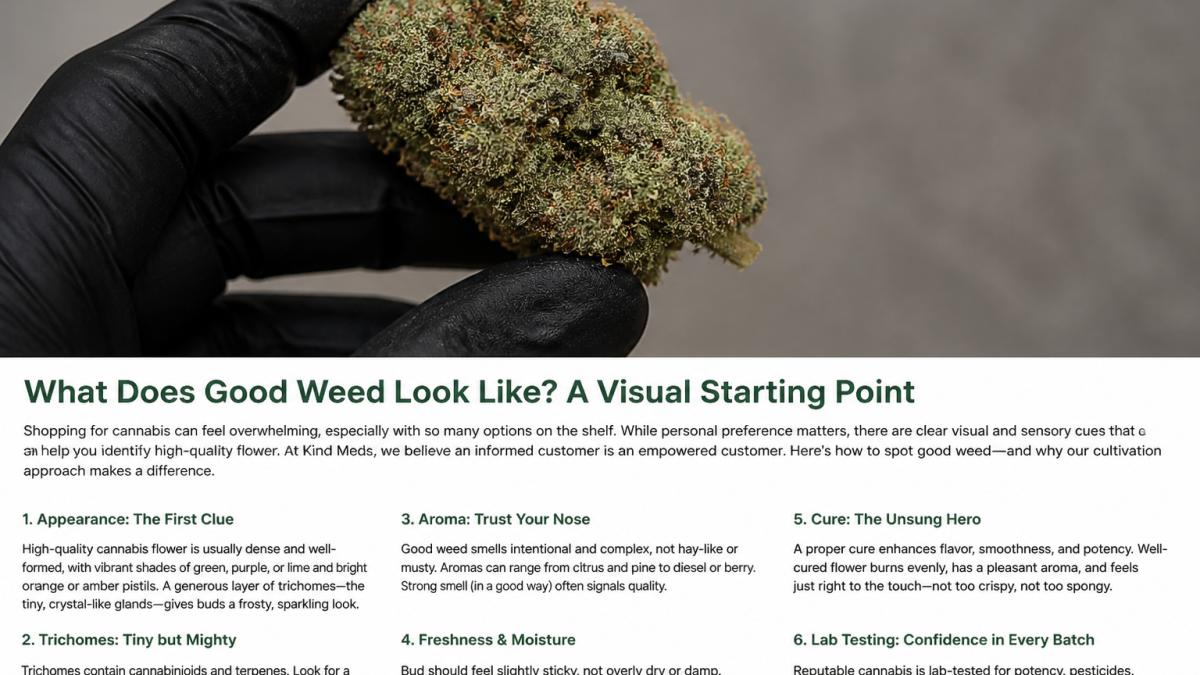
One common mistake: judging a whole jar by the prettiest bud on top. Ask to see the actual unit you’re buying, or look closely at what’s in the package.
Cannabis Trichomes: The Resin Glands That Signal Quality
Cannabis trichomes are the tiny resin glands on the flower surface that produce cannabinoids and terpenes. They look like a fine frost or sugar coating. Strong trichome coverage is one of the clearest visual quality indicators you can spot without a lab report.
Under magnification, trichomes look like small mushrooms. Clear ones suggest the plant was harvested early. Milky ones suggest a mature harvest. Amber ones suggest later harvest. Many growers aim for a mix, though the “right” ratio is a matter of preference, not a rule.
What most guides miss: trichomes degrade with handling. A bud that’s been knocked around in a bag loses resin. So does one exposed to heat or light. Frost on the outside of a package doesn’t count for much.
- Look for frost on the calyxes, not just the sugar leaves
- Check that the coating looks intact, not rubbed off in patches
- Compare buds in the same jar for consistency
How to Identify High Quality Flower by Bud Structure and Texture
The best way to identify high quality flower by feel is the squeeze test. A fresh bud should feel firm and slightly springy. Press it gently and it should push back, then return to shape.
Dense buds are usually a good sign, but density alone doesn’t prove quality. Some cultivars naturally grow airier. What matters is that the structure is intact and the trim is clean.
Here’s what to watch for:
- Firm texture: holds shape under light pressure
- Clean trim: few loose sugar leaves, no big stems
- Intact calyxes: the little seed-shaped pods are whole, not crushed
- No crumble: dry, dusty buds that fall apart signal poor storage
A common mistake is equating rock-hard density with quality. Over-compressed buds can hide problems and lose aroma. Texture should feel natural, not forced.
Aroma, Terpenes, and What Your Nose Tells You
Terpenes are the aromatic compounds that give cannabis its smell and much of its character. A strong, pleasant scent is one of the most reliable quality indicators, and your nose often catches what your eyes miss.
Fresh cannabis flower should smell like something. Citrus, pine, earth, fuel, berries: the specific note matters less than the intensity and clarity. A faint or hay-like smell usually points to old product or poor curing.
- Bright, layered aroma: a good sign of healthy terpene content
- Hay or grass smell: often means poor drying or long storage
- Ammonia or musty notes: a red flag for mold or contamination
- No smell at all: usually old or overheated flower
What most guides miss is that smell changes with temperature. A cold jar mutes aroma. Let the bud sit at room temperature for a minute before you judge it.
Fresh Cannabis Flower: Moisture, Curing, and Storage Clues
Fresh cannabis flower holds the right balance of moisture: not wet, not bone dry. Proper curing and storage preserve that balance, and the difference shows up the moment you handle the bud.
Curing is the slow drying and aging process that develops flavor and smooths the smoke. Rushed curing leaves a harsh product. Good curing takes patience, and it’s hard to fake. But curing is only half the story.
Start with the dates. Most regulated packaging carries a harvest date and a package date, and sometimes a test date. These are not the same thing, and the gap between them matters:
- Harvest Date and Curing: A harvest date alone does not determine cannabis quality. Properly cured flower can develop a smoother smoke, richer flavor, and a more complex aroma over time. As cannabis ages, its cannabinoid and terpene profiles can change, potentially affecting the experience. The quality of the cure, storage conditions, and individual strain matter more than simply choosing the newest harvest.
- Package date tells you when the flower was sealed for sale. A package date close to the harvest date suggests the product moved quickly; a long gap can mean the flower sat in storage before packaging.
- Test date tells you when the batch was sampled. A test date far from the package date is worth a question.
A practical rule: fresher is generally better, but fresh-looking dates on a poorly stored package can still mislead. Dates are a starting point, not a guarantee.
Next, check the packaging and the bud itself:
- Sealed, opaque packaging protects flower from light and air better than clear bags or loose jars. Light degrades resin, and air dries flower out.
- No condensation inside the package. Moisture buildup is a red flag for mold.
- Springy, not brittle: the bud bends slightly before it breaks.
- Sticky fingers: resin should leave a little tack behind.
- No crumble: dry, dusty buds that fall apart signal overdrying or long storage.
Storage at home matters just as much. Flower kept in a sealed container away from light and heat holds up far better than flower left in a warm car or a clear bag. A common pattern is that shoppers blame the dispensary for dry flower when the real culprit is a week in a hot glovebox.
Cannabis Flower Lab Testing and Product Verification
Cannabis flower lab testing is the process where a sample is analyzed for cannabinoid content, terpenes, and contaminants like mold, pesticides, and heavy metals. In Colorado, licensed cannabis products are required to pass state-mandated testing before sale, and the results are tied to a specific batch.
The most useful skill here is reading a certificate of analysis, or COA. A COA is the lab report that accompanies a tested batch. Most shoppers never ask for one, which is exactly why asking sets you apart.
Here is how to read a COA in practice:
- Match the batch or lot number. The number on the COA must match the number on the package. A COA for a different batch tells you nothing about the flower in your hand.
- Check cannabinoid results. Look beyond THC and CBD. A complete cannabinoid profile may include lesser-known cannabinoids such as CBG, CBN, THCV, CBC, and CBDV. These minor cannabinoids are often found in smaller concentrations, and some are more difficult to produce in significant amounts due to genetics, cultivation conditions, and the plant’s natural chemistry. Each cannabinoid has unique properties, and the combination of cannabinoids and terpenes may influence the overall cannabis experience. High THC alone does not define premium flower.
- Review terpene results. A COA that lists individual terpenes (myrcene, limonene, pinene, caryophyllene, terpinolene) tells you more about aroma and character than a total terpene percentage alone.
- Confirm contaminant screening. Look for pass results on mold, yeast, bacteria, pesticides, heavy metals, and residual solvents. A COA that omits a contaminant panel is incomplete.
- Check the test date. A COA from many months ago may not reflect the condition of the flower today, especially if storage has been poor.
A common pattern is that shoppers focus on the THC number and ignore everything else. That is backwards. The contaminant panel and the terpene profile usually tell you more about whether a product was handled well than a single potency figure does.
At Kind Meds, our vertically integrated setup means we grow, extract, and sell our own product, so we can speak to how it was handled from cultivation to sale.
Indoor vs. Outdoor Flower and the Limits of Visual Inspection
Indoor and outdoor flower each have real strengths, and neither wins outright. Indoor growing gives tight control over light, temperature, and humidity, which often produces consistent, dense buds with strong trichome coverage. Outdoor growing uses natural sunlight and soil, and many shoppers prefer its character and aroma.
The fair comparison:
- Indoor: consistent structure, often heavier resin, higher input cost
- Outdoor: natural terpene expression, seasonal variation, sometimes airier buds
- Both: quality depends far more on the grower than the setting
Here’s the limit nobody likes to admit: you cannot judge potency by appearance. Frosty, dense, great-smelling flower tells you a lot about care and freshness. It tells you nothing reliable about how strong it is or how it will affect you. Potency claims belong on the lab report, not in a bud photo.
That’s also why we encourage questions. Whether you’re shopping medical or recreational, our teams in Denver and Colorado Springs would rather talk through what you’re looking for than have you guess.
Conclusion
Reading flower well takes practice, and even experienced shoppers get surprised. The good news is that the signals are learnable: color, trichomes, structure, aroma, moisture, and lab results together tell a fuller story than any single trait.
At Kind Meds, we’ve been Colorado-owned and operated since 2009, and we grow, extract, and sell our own product, including our Mother, Origin indoor flower. That vertical setup lets us stand behind what we carry. If you want help applying these checks to a real jar, stop by either location or order online for same-day in-store pickup. Our team will walk you through the flower and help you find what fits.
Frequently Asked Questions
What should high-quality cannabis flower look and smell like?
High quality flower usually shows vivid green or purple hues, a visible frost of trichomes, and intact orange pistils. The buds should feel dense but springy, not crumbly or spongy. Aroma matters just as much: a fresh, complex scent that matches the strain’s terpene profile signals proper curing, while a hay-like or musty smell can point to poor drying or age. Use your eyes and nose together, then confirm with lab testing and package dates before you buy.
How can you tell if cannabis flower is fresh?
Squeeze a bud gently. Fresh cannabis flower springs back and feels slightly sticky from resin, while overly dry flower crumbles and older flower feels brittle. Check the package or harvest date, look for a strong terpene-rich aroma when you open the container, and inspect trichomes for a cloudy, frosty appearance. Properly stored flower keeps its moisture and smell far longer than flower left in a hot car or a dry room.
What do cannabis trichomes tell you about flower quality?
Cannabis trichomes are the tiny resin glands that coat the bud and hold cannabinoids and terpenes. A thick, evenly distributed layer of cloudy trichomes usually signals a plant harvested near peak maturity. Clear trichomes suggest an earlier harvest, and amber trichomes indicate later maturity. Trichome coverage alone does not prove potency, so treat it as one quality indicator alongside aroma, bud structure, and lab results rather than a guarantee of effects.
How can you check cannabis flower lab results?
Ask the dispensary for the batch’s certificate of analysis, which lists cannabinoid content, terpene profile, and safety tests for mold, pesticides, and heavy metals. Match the batch or harvest number on the label to the certificate so you know the results belong to the flower you are buying. Reputable shops will show you the paperwork or point to it online. If a provider cannot produce testing records for a batch, treat that as a reason to look elsewhere.
Ready to put these tips to use? Browse our current flower selection and order online for pickup at Kind Meds in Denver or Colorado Springs.