Table of Contents
- How to Choose Cannabis for Arthritis: Start With Your Symptoms
- CBD for Arthritis Pain: What the Evidence Shows and Where THC Fits
- Indica or Sativa for Arthritis: Matching Strains to Daytime and Nighttime Needs
- The Best Cannabis Products for Pain: Comparing Delivery Methods
- A Step-by-Step Selection and Trial Plan for Cannabis for Arthritis
- Medication Interactions and What to Discuss With Your Clinician
- Product Quality, Labeling, and Testing: What to Check Before You Buy
- Conclusion
- Frequently Asked Questions
Last Updated: October 21, 2026
How to Choose Cannabis for Arthritis: Start With Your Symptoms
Arthritis is not one condition, and cannabis is not one product. That single fact explains why so many people get disappointing results. Learning how to choose cannabis for arthritis starts with naming your specific symptoms: morning stiffness, constant joint pain, inflammation flares, or sleep that falls apart because the ache won’t quit.
At Kind Meds, we’ve served Colorado since 2009, and the question we hear most is some version of “what should I try?” The honest answer is that no product works the same way for two people. But you can stack the odds in your favor.
Start by writing down three things:
- Your main symptom (pain, stiffness, swelling, or sleep)
- When it’s worst (morning, evening, after activity)
- How it responds to what you already use
That list becomes your filter. A product that helps evening pain may do nothing for morning stiffness. Match the product to the symptom, not the other way around.
CBD for Arthritis Pain: What the Evidence Shows and Where THC Fits
CBD for arthritis pain gets more marketing attention than almost any other cannabis topic. The evidence is still early. Clinical research on cannabinoids and joint pain exists, but most studies are small, and results vary. Current research has not established CBD as an effective treatment for arthritis. Some consumers report benefits, but results vary, and CBD should not replace prescribed arthritis treatment.
The bigger point: CBD and THC work differently.
- CBD does not produce a high. Many people use it for inflammation and general discomfort.
- THC produces psychoactive effects and is often what people associate with stronger pain relief.
- Balanced CBD:THC products aim to split the difference.
A common mistake is buying a high-CBD product and expecting instant results. CBD often needs consistent daily use before you notice anything. THC works faster but comes with impairment you need to plan around.
Indica or Sativa for Arthritis: Matching Strains to Daytime and Nighttime Needs
The indica or sativa for arthritis question is the one we get asked most, and the honest answer is that those two labels are a poor guide. Most commercial cannabis is a hybrid, the same cultivar can be sold under different names by different sellers, and the effects you actually feel track cannabinoid ratios and terpene content far more closely than they track the plant’s family tree. Treat indica and sativa as loose marketing shorthand, not pharmacology.
What actually matters is timing and chemistry. Build your choice around three variables: the CBD:THC ratio, the total THC dose, and the dominant terpenes.
Daytime use some consumers prefer CBD-dominant products with lower THC levels. However, THC can impair judgment, coordination, and reaction time even at low doses. Never drive or operate machinery while impaired by cannabis. Look for low-THC, higher-CBD options, think ratios in the range of 5:1 to 20:1 CBD:THC, or a gentle hybrid with modest total THC. You want symptom relief without fog. A common pattern is a CBD-dominant tincture in the morning and early afternoon, with THC held in reserve for breakthrough pain.
Nighttime use is where stronger THC products earn their place. If pain keeps you awake, a heavier, THC-forward product taken 60 to 90 minutes before bed can help you settle. Pair it with a sedating terpene profile rather than relying on the indica label alone.
Terpenes are the part most buyers skip, and they are where the real selection happens:
- Myrcene is the terpene most associated with sedating, body-heavy effects. It shows up in many nighttime cultivars.
- Limonene and pinene appear in brighter, more alert profiles, useful for daytime stiffness without couch-lock.
- Caryophyllene is worth knowing because it binds directly to CB2 receptors, one of the few terpenes with a well-described receptor interaction. It appears in many peppery, spicy cultivars.
- Linalool shows up in floral profiles and is often paired with relaxation-oriented products.
Ask what terpenes a product carries and in what amounts, not just whether it’s labeled indica. A lab report with a terpene panel tells you more than any strain name on the jar.
A practical way to match product to symptom:
| Symptom pattern | Ratio to start with | Terpene lean | Timing |
|---|---|---|---|
| Morning stiffness | CBD-dominant (5:1 or higher) | Limonene, pinene | Morning |
| Constant daytime joint pain | Balanced 1:1, low total THC | Caryophyllene, limonene | Midday |
| Evening flare after activity | Balanced to THC-leaning | Myrcene, caryophyllene | Late afternoon |
| Pain disrupting sleep | THC-leaning | Myrcene, linalool | 60-90 min before bed |
One more caution: cultivar names are not standardized. “Blue Dream” from one producer is not chemically identical to “Blue Dream” from another. Buy by batch and by lab report, not by name recognition.
The Best Cannabis Products for Pain: Comparing Delivery Methods
The best cannabis products for pain depend on how fast you need relief, how long you need it to last, and how precisely you need to control the dose. Delivery method changes onset, duration, intensity, and dose control more than strain name does, which is why this is the decision most worth slowing down for.
| Method | Onset | Duration | Dose control | Best for |
|---|---|---|---|---|
| Inhalation (flower, vape) | 2-10 minutes | 1-3 hours | High, titrate puff by puff | Fast relief, learning your dose |
| Oral (edibles, capsules, tinctures) | 30-120 minutes | 4-8 hours | Moderate, fixed per serving | All-day or overnight coverage |
| Sublingual tincture | 15-45 minutes | 3-6 hours | High, measured dropper | Middle ground, adjustable |
| Topical (creams, balms, patches) | 15-45 minutes | 1-4 hours | Low, localized only | Surface joints: hands, knees |
| Concentrates (RSO, live resin) | Minutes to 1 hour | Varies | Low, very potent | Experienced users only |
Inhalation gives you the fastest feedback, which makes it the easiest way to learn your dose. The trade-off is duration, most people need to re-dose every couple of hours, and inhaled cannabis irritates airways. It is a poor fit for anyone with respiratory conditions.
Oral products last longer but are harder to fine-tune. Edibles and capsules deliver a fixed dose per serving, and because the liver converts THC to a more potent metabolite during first-pass metabolism, the effect can feel stronger and longer than the same amount inhaled.
Sublingual tinctures are the underrated middle ground. A measured dropper under the tongue bypasses some first-pass metabolism, comes on faster than an edible, and lets you adjust in small increments. For arthritis patients who want all-day coverage without the unpredictability of edibles, a tincture is often the most practical starting point.
Topicals won’t get you high and work well for hands, knees, and other surface joints. They are a reasonable adjunct for localized discomfort, but the evidence for deep-joint effect is limited, treat them as comfort support, not a systemic solution.
Concentrates are potent and best left to people with established tolerance. A rice-grain-sized amount of RSO can deliver more THC than a new user should take in a day. For more information about RSO, including potency, dosing, and consumption methods, read our How to Use RSO beginner’s guide.
A decision rule that works for most people:
- If you need relief within the hour, start with inhalation or a sublingual tincture.
- If you need all-day or overnight coverage, start with an oral product or tincture and accept the slower onset.
- If the discomfort is localized to hands or knees, add a topical alongside your systemic product.
- If you are brand new, start with one method, usually inhalation for dose-learning or a low-dose tincture, and add nothing else for two weeks.
Start with one method. Adding three at once makes it impossible to know what helped.
A Step-by-Step Selection and Trial Plan for Cannabis for Arthritis
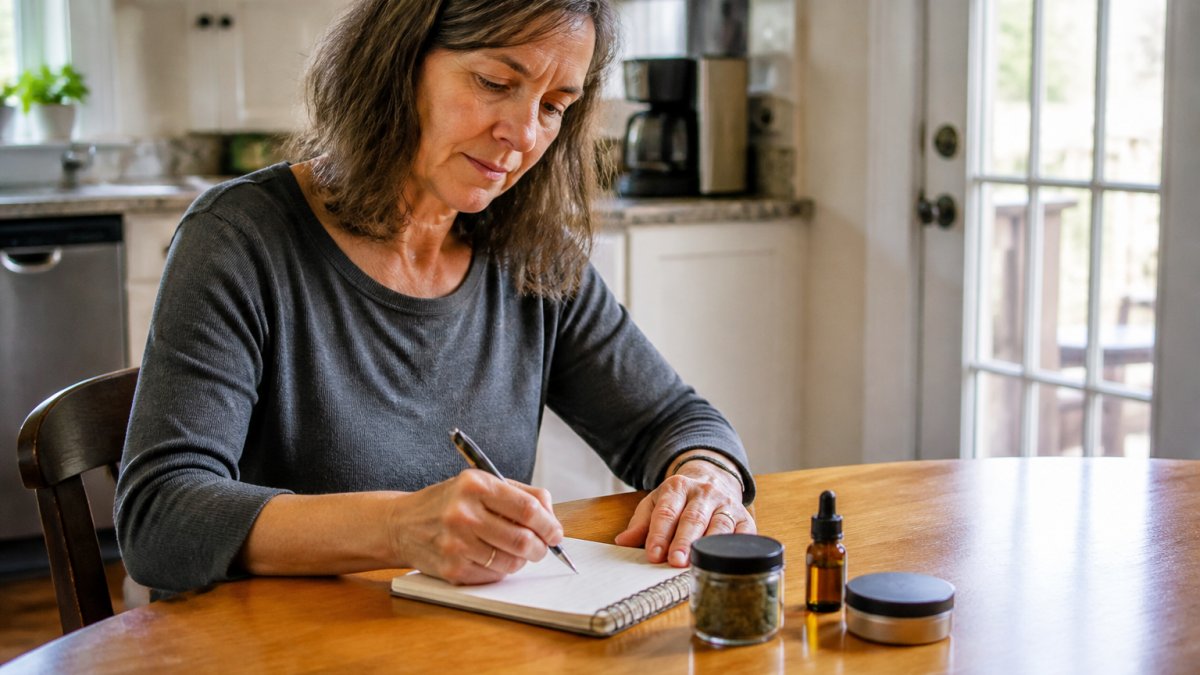
A structured trial is the difference between guessing and knowing. Here is the plan we walk customers through.
- Pick one symptom and one product. Choose your worst symptom and a single product that targets it.
- Set a starting dose. For inhalation, one or two puffs. For oral, start at the lowest labeled serving.
- Log every session. Note time, dose, symptom level before and after, and any side effects.
- Hold the dose for three to five days. Don’t increase until you’ve seen the pattern.
- Adjust one variable at a time. More product, different ratio, or new method. Never two at once.
- Review after two weeks. Keep what clearly helped. Drop what didn’t.
Medication Interactions and What to Discuss With Your Clinician
Cannabis can interact with other medications, and arthritis patients often take several. This is not a reason to avoid the conversation; it’s a reason to have it.
Bring a list of everything you take, including over-the-counter drugs. Ask your clinician about:
- Blood thinners and how cannabis might affect them
- Any medication processed by the liver
- Sedatives or sleep aids, since THC can compound drowsiness
- How cannabis might affect your arthritis treatment response
Be direct about what you’re using and how much. Clinicians can’t give useful guidance on half the story.
Product Quality, Labeling, and Testing: What to Check Before You Buy
Label accuracy varies across the industry, and testing standards differ by state. You can’t verify a product yourself, so buy from sellers who publish lab results and can explain them.
Check these before you buy:
- Batch-specific test results for potency and contaminants
- Clear cannabinoid content in milligrams, not vague percentages
- Harvest or packaging dates so you know how fresh it is
- Terpene profiles if you’re matching effects
- A staff member who can answer questions without deflecting
Conclusion
Choosing cannabis for arthritis is a process, not a purchase. Name your symptom, pick one product, start low, and track what happens. Bring your medication list to your clinician. Buy from sellers who show their testing.
If you’re in the Denver or Colorado Springs area, our team at Kind Meds can walk you through product options, ratios, and dosing one on one. We’ve been serving Colorado since 2009, and we’d rather answer your questions than rush a sale. Order online for same-day pickup, and let us help you find what actually works for your joints.
Frequently Asked Questions
Which type of cannabis is better for arthritis, indica or sativa?
Neither type is proven better for arthritis. The indica versus sativa label describes plant lineage and typical effects more than medical performance. Indica-leaning strains are often chosen for evening use because they tend to feel more sedating, while sativa-leaning strains are often picked for daytime when you want less drowsiness. What matters more is the cannabinoid ratio, the dose, and how your body responds. Start with a low dose of a product you can measure precisely, note whether it helps joint pain or stiffness, and adjust from there.
What form of cannabis is best for chronic pain?
There is no single best form. Inhaled products like flower or vaporizers act within minutes, which makes them useful for flare-ups but harder to dose precisely. Oral products such as capsules, tinctures, and edibles take longer to act, often 30 to 90 minutes, and last longer, which suits ongoing joint stiffness. Topicals are applied directly to a painful joint and do not produce a high. Many people combine a fast-acting option for bad days with a longer-lasting oral product for baseline symptom management.
Do CBD gummies really help arthritis?
Evidence for CBD in arthritis is limited and mostly comes from early research rather than large clinical trials. Some people report less joint pain and stiffness, but responses vary widely. Gummies are a convenient oral option, though dosing is fixed per piece and onset is slow. If you try CBD for arthritis pain, choose a product with a clear label showing cannabinoid content and third-party testing, start with a low dose, and give it a consistent trial of a week or two before judging whether it helps.
What should people with arthritis ask a health care professional before trying cannabis?
Ask whether cannabis could interact with your current medications, especially blood thinners, immunosuppressants, and drugs metabolized by the liver. Bring a list of everything you take, including supplements. Ask about your arthritis subtype and whether cannabis fits alongside your existing treatment plan. Also ask how to recognize side effects like dizziness or drowsiness and when to stop. A clinician can help you set realistic expectations and a safe starting dose, particularly if you are older or managing other health conditions.