Last Updated: November 12, 2026
Quick Summary
To read a cannabis lab test result, find the Certificate of Analysis and confirm the batch number on the report matches the batch number on your package. Then check the total THC line rather than the raw THCA percentage, and verify that every safety panel shows a pass result.
- A COA from a prior batch says nothing about the jar in your hand, even for the same strain.
- Raw flower contains mostly THCA, which converts to THC when heated through decarboxylation.
- Percentage describes concentration for flower and concentrates, while milligrams apply to edibles and tinctures.
- A result listed as ND means not detected at the test’s limit, not zero.
- Concentrates and cartridges add a residual solvents panel because extraction uses them.
Table of Contents
- Start With the Cannabis Certificate of Analysis
- Reading THCA Lab Results and Total THC
- What CBD, CBG, and CBN Numbers Tell You
- Making Sense of Cannabis Terpene Test Results
- Cannabis Contaminant Testing and Safety Panels
- How to Verify a COA and Spot Red Flags
- Checking Lab Reports at Our Denver and Colorado Springs Stores
- Order Online and Review the COA at Pickup
- Frequently Asked Questions
Start With the Cannabis Certificate of Analysis
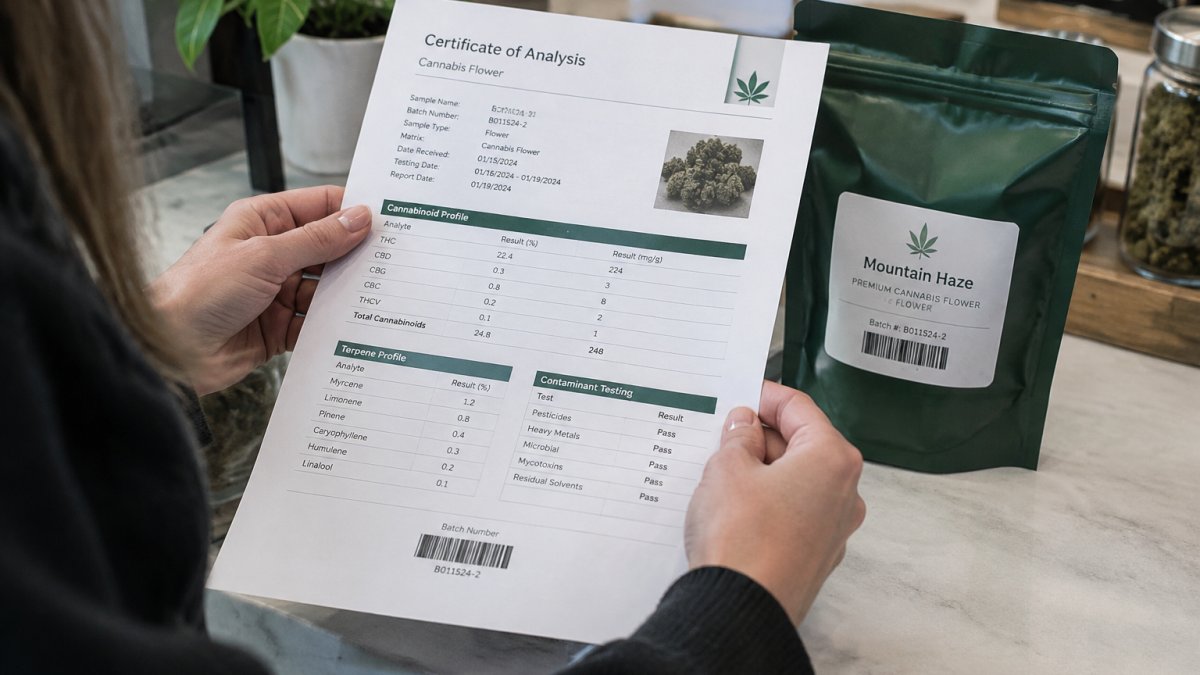
A cannabis Certificate of Analysis is a lab report that shows what testing found in a specific batch of cannabis. It lists cannabinoids, terpenes, and safety panels.
The COA is your answer, but only if you read it correctly.
The report tells you what is in the batch. It cannot tell you what is right for you.
Fields Every COA Should Show
A complete report carries a set of identifiers you can check. Look for:
- Product name and product type
- Batch number or lot number
- Sample ID assigned by the lab
- Test date and report date
- Laboratory name and license or accreditation details
- Cannabinoid results
- Terpene results
- Safety panels: pesticides, heavy metals, microbials, residual solvents, moisture
If any of these are missing, treat the report as incomplete.
Matching the Report to Your Exact Package
The batch number on the report must match the batch number on your package. Not the product name. Not the strain name. The batch.
A farm can harvest the same strain many times. Each harvest gets its own batch and its own report. A COA from a prior batch says nothing about the jar in your hand.
Reading THCA Lab Results and Total THC
THCA lab results show the raw, unheated form of THC. Total THC estimates what you actually get after heat converts THCA.
Raw flower contains mostly THCA. Decarboxylation, which happens when you heat cannabis, converts THCA into THC (Decarboxylation Study of Acidic Cannabinoids).
A common mistake is reading the THCA percentage as if it were the THC percentage. It is not.
Potency is also not a pass/fail test. As Glass House Farms explains in its COA guide, potency testing measures cannabinoid and terpene content.
Percentages, Milligrams, and Serving Sizes
Percentages and milligrams answer different questions. Percentage tells you concentration. Milligrams tell you quantity.
- Percentage applies to flower and concentrates. It describes how much of the product’s weight is a given cannabinoid.
- Milligrams apply to edibles and tinctures. They describe the amount per package and per serving.
- Mg per serving is the number to check before you eat anything.
An edible package might list total milligrams for the whole item and milligrams per serving separately. Read both. A single piece is not always a single serving.
What CBD, CBG, and CBN Numbers Tell You
CBD, CBG, and CBN numbers describe other cannabinoids in the batch. CBD is the non-intoxicating cannabinoid most people know.
You will often see CBDA alongside CBD, and THCA alongside THC. The “A” stands for the acid form, which converts with heat. Reports usually list both the raw and converted totals.
What most guides miss is that a big CBD number does not cancel out THC. A product can carry meaningful amounts of both.
Making Sense of Cannabis Terpene Test Results
Cannabis terpene test results list the aromatic compounds in the batch, usually as percentages. Terpenes drive smell and flavor.
Common terpenes on a report include myrcene, limonene, pinene, linalool, and caryophyllene.
Two batches of the same strain can show different terpene profiles. That is normal. Growing conditions, harvest timing, and curing all shift the numbers.
If you want to go deeper on what these compounds do, our guide to cannabis terpenes covers the profiles in plain language.
Cannabis Contaminant Testing and Safety Panels
Cannabis contaminant testing covers the panels that have nothing to do with potency. These tests look for things that should not be in your product, and they are the part of the report most people skip.
The standard safety panels include:
- Pesticides: residues from growing, screened against a list of allowed and prohibited compounds
- Heavy metals: lead, arsenic, cadmium, and mercury
- Microbials: mold, yeast, and bacteria, including total yeast and mold counts and specific pathogens
- Residual solvents: leftovers from extraction, such as ethanol or hydrocarbons
- Moisture content and water activity: indicators of stability and mold risk
- Foreign matter: stems, seeds, and non-cannabis material
A report should show a result for each panel, not just a checkmark. Look for the word “Pass” or a reported value below the stated limit. Each panel has its own action limit.
Detection Limits and What They Mean
Every lab test has a floor. The detection limit is the smallest amount the equipment can reliably see (the EPA).
A result listed as “ND” means not detected at that limit. It does not mean zero. It means below what the test could measure.
This is where measurement uncertainty comes in. Labs report results with a margin. Two labs testing the same sample can post slightly different potency numbers. That is normal variation, not fraud.
What a Failed Panel Actually Means
A failed panel is not always a recall. It means the batch did not meet the action limit for that test under the rules the lab applied. Some failures are correctable through re-testing or remediation, and some are not.
Watch out: a report that shows a fail on any panel, or that omits a panel entirely, should be treated as unresolved until someone can explain it. Ask the retailer for the matching report and a clear answer before you buy.
Matching the Panel to the Product Type
Not every cannabis product requires the same laboratory tests. Testing requirements vary depending on the product type, production method, and applicable Colorado regulations. Independent laboratory testing plays an important role in product safety, transparency, and accountability.
If you want to build your cannabis literacy further, our education hub walks through labels, dosing, and product types.
How to Verify a COA and Spot Red Flags
Verifying a report takes about two minutes. Start with the batch number, then work through the identifiers. Most guides stop at the checklist. The part that actually protects you is knowing how to confirm the report is real and what to do when it is not.
- Batch number on the report matches the package
- Test date is recent relative to the package date
- Lab name and license number are printed
- Sample ID is listed
- Every safety panel shows a result
- Potency numbers are consistent with the product type
- The report is not a photocopy with altered fields
Confirming the Report Is Authentic
A printed COA is easy to fake. The stronger check is the source. Many labs publish reports through an online portal, and many packages carry a QR code that opens the report directly from the lab.
Look for the lab’s license or accreditation details on the report itself. A report with no lab name, no license number, and no sample ID cannot be traced back to a testing facility, which means it cannot be verified at all.
Spotting Mismatched, Expired, or Questionable Reports
A COA from a prior batch says nothing about the jar in your hand, even if the strain name is identical. A farm can harvest the same strain many times, and each harvest gets its own batch and its own report.
Age matters too. A test date that is far older than the package date suggests the report may not reflect the current batch. Potency can shift during storage, and contaminant results are only as good as the sample they came from.
What to Do When Results Are Missing or Inconsistent
If a report is missing, ask the retailer for the matching COA before you buy. If the report you receive does not match the package batch, ask for the correct one.
You do not need to be a chemist to do this. You need the batch number, the test date, and a report that traces back to a licensed lab. If you want to build your cannabis literacy further, our education hub walks through labels, dosing, and product types.
Checking Lab Reports at Our Denver and Colorado Springs Stores
Kind Meds is an independently owned, vertically integrated Colorado cannabis company established in 2009. With deep medical cannabis roots, we believe product transparency, responsible manufacturing, consistency, and customer education are essential to earning consumer trust.
Denver: Our Denver location serves medical and recreational shoppers. You can also review store details on our Denver location page.
Colorado Springs: Our Colorado Springs location serves both medical and recreational cannabis customers. Bring your questions about cannabis lab results, product quality, and specific batches. For store hours, directions, and additional information, visit our Colorado Springs location page.
SHOP COLORADO SPRINGS – ORDER ONLINE
If flower is what you are after, you can browse our flower selection and check batch reports when you pick up. Concentrate shoppers can do the same with our concentrates lineup.
Order Online and Review the COA at Pickup
Place your order, then ask for the COA when you arrive. The batch number on the jar should match the report the team hands you.
Here is a quick reference for what each field means:
| Field on the Report | What It Tells You | What to Check |
|---|---|---|
| Batch or lot number | Which production run this is | Matches your package |
| Test date | When the sample was tested | Recent relative to packaging |
| Total THC | THC after heat conversion | The number that reflects effect |
| Total CBD | CBD after heat conversion | Listed separately from THC |
| Terpene profile | Aroma compounds and percentages | Consistency with strain |
| Safety panels | Pesticides, metals, microbials, solvents | A passing result on every applicable required safety panel |
| Detection limit | Smallest amount the lab can see | “ND” means below limit, not zero |
Reading a COA is a habit, not a one-time task. Check the batch number first, then the total THC line, then the safety panels.
Frequently Asked Questions
How do I read THC and THCA results on a cannabis lab report?
Look for three separate numbers: THC, THCA, and total THC. THCA is the raw, non-intoxicating form that converts to THC when heated. Total THC combines the already-active THC with the THC that THCA will become, so it is the number that best reflects what you will feel. A label showing 1% THC and 22% THCA is not a low-potency product; the total THC is closer to 20%. Always check total THC before comparing two products.
What does a cannabis Certificate of Analysis show?
A cannabis Certificate of Analysis is the report issued by a licensed laboratory after testing a specific batch. It lists the batch or lot number, sample ID, test and report dates, cannabinoid potency (THC, THCA, CBD, CBDA, CBG, CBN), terpene profile, and safety panels for pesticides, heavy metals, microbials, mold, yeast, and residual solvents. It may also include moisture content and water activity. The COA is your proof that the product was tested and matches the package.
Do higher terpene levels mean a better cannabis experience?
Not necessarily. Terpene percentages show concentration, not quality or effect. A strain with 2% total terpenes is not automatically better than one with 1.2%. What matters more is which terpenes are present and how they combine with cannabinoids. Myrcene, limonene, and caryophyllene each contribute different aromas and may influence how a strain feels, but potency results should not be treated as a pass/fail quality test. Use the terpene profile to match flavors and aromas you already enjoy.
How can I tell whether a cannabis lab test is current?
Check the test date and report date on the COA and compare them to the package’s harvest or manufacture date. A report that is many months older than the product on the shelf deserves a question. Also confirm the batch or lot number on the COA matches the one printed on your package exactly. If the numbers do not match, or the report has no sample ID, ask the dispensary staff for the correct report before you buy.